What this means in plain English: Padauk moves a little — a 24-inch flatsawn board will grow and shrink about 0.42 inches across its width between a humid summer and a dry winter. It’s stable enough for flatsawn panels as long as you account for the width change.
How much it moves at common board widths
Find the width of your board on the left. Find your expected moisture swing along the top (8% is typical for a heated/cooled house; 12% is typical outdoors or in a shop without climate control). The number inside the table is how many inches the board will grow and shrink across its width. That’s your slot size.
| Board width | Δ4% MC | Δ6% MC | Δ8% MC | Δ12% MC |
|---|---|---|---|---|
| 6 in | 0.053" | 0.080" | 0.106" | 0.159" |
| 12 in | 0.106" | 0.159" | 0.212" | 0.318" |
| 18 in | 0.159" | 0.239" | 0.318" | 0.477" |
| 24 in | 0.212" | 0.318" | 0.424" | 0.636" |
| 36 in | 0.318" | 0.477" | 0.636" | 0.955" |
How to use it: find your board width in the left column and the expected moisture content change across the top. The cell is the total inches of cross-grain expansion and contraction you should plan for — elongated slots, breadboard clearances, and panel gaps all come from this number.
About Padauk
- Color
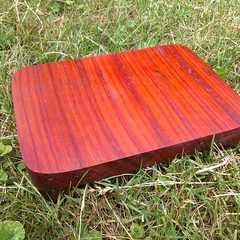
- Vivid orange-red when fresh, darkens to deep reddish brown over time.
- Grain
- Straight to interlocked, coarse open texture.
- Workability
- Generally easy to work despite density, can stain adjacent surfaces.
- Durability
- Very durable, excellent decay and insect resistance.
- Common uses
- Accents, flooring, turning, musical instruments.
- Typical price
- $8-14/bf
- Specific gravity
- 0.74 (oven-dry)
- Modulus of elasticity
- 2,170 × 1,000 psi
The math, explained once
Three numbers multiplied together. That’s it.
width (in) × coefficient × ΔMC (%) = movement (in)
- Width is how wide the board is, measured across the grain.
- Coefficient is the number at the top of this page (tangential 0.00221 for flatsawn, radial 0.00117 for quartersawn).
- ΔMC is how many percentage points the moisture content will change between seasons. Indoor heated spaces: around 8. Shops, garages, or outdoor pieces: 10–14.
These coefficients come from the USDA Forest Products Laboratory and published wood science data. Dead On uses the same numbers on iPhone, iPad, and Apple Watch — your shop math matches your field math.
Calculate Padauk movement in your project
Dead On has this species built in, alongside 29 others — with visual diagrams for dovetails, box joints, mortise & tenon, and more.
Download Dead On — FreeFrequently asked questions about Padauk
How much does Padauk move seasonally?
A 24" wide flatsawn Padauk board will move about 0.42" across the grain with an 8% change in moisture content (typical indoor seasonal swing). The tangential coefficient is 0.00221 per 1% MC change, the radial coefficient is 0.00117.
Is Padauk stable enough for wide tabletops?
Padauk is stable. The tangential-to-radial ratio is 1.89 (lower is more stable; values under 2.0 are ideal for wide panels). For the most stable results, use quartersawn stock or breadboard ends with elongated slots for seasonal movement.
What is Padauk typically used for?
Accents, flooring, turning, musical instruments.
Is Padauk a hardwood or softwood?
Padauk is a hardwood. Its Janka hardness rating is 1970 lbf and specific gravity is 0.74.
Species with similar movement
Hardwoods with tangential coefficients closest to Padauk’s 0.00221. If your project plan calls for Padauk but availability is tight, these behave most like it through the seasons.